How to Choose a Self-Loading Concrete Mixer Manufacturer in China
Search “self-loading concrete mixer manufacturer” and you will get hundreds of Chinese companies, most of them looking identical: same stock photos, same claims, same certificates. Very few are actually factories. This is the checklist we would use if we were the buyer.
1. Establish whether they build or resell
The fastest test is a live video call from the production floor, with today’s date written on a whiteboard. A factory can do this in ten minutes. A trading company will offer a pre-recorded video, a “the workshop is far away” excuse, or photos you can reverse-image-search and find on three other websites.
Second test: ask a question only production can answer — what steel grade is the load-bearing frame, what is the weighing accuracy, which brand of reduction gearbox. A factory answers on the spot.
2. Check the paperwork against the right entity
- Business licence — a manufacturer’s registered scope includes production; a trader’s lists wholesale and import/export only.
- Patents — ask for patent numbers and check they are held by the same legal entity that will sign your contract.
- Certification — confirm the certificate covers the actual model you are buying and is valid for your destination market.
3. Judge the product line, not the catalogue
A specialist that builds one product family well is usually a safer bet than a company listing mixers, excavators, cranes and generators on the same page — that pattern is almost always a trader. Ask how long they have made this machine and how many units per year.
4. Interrogate the engineering that actually fails
On self-loading mixers, problems concentrate in a few places. Ask specifically about:
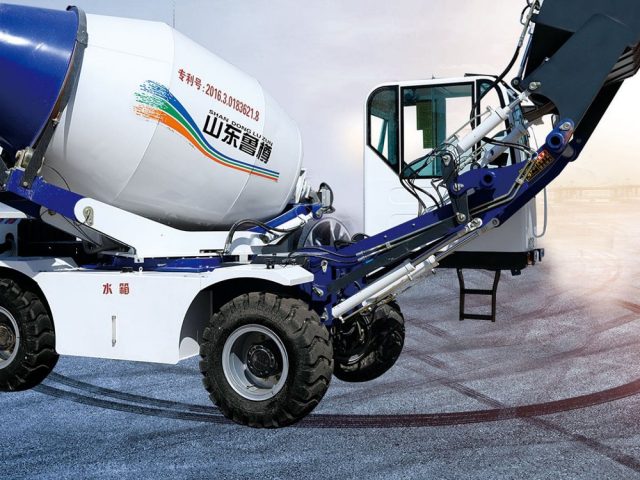
- Loading arm and drum steel — alloy steel such as 40Cr on load-bearing parts, wear-resistant drum liner
- Mixing screws — spiral design determines mix uniformity and whether the drum discharges completely
- Drive line — articulated 4×4 with planetary reduction if you work on slopes or soft ground
- Weighing system — accuracy and repeatability, because this is what makes the concrete project-grade
- Discharge — 270° slew saves enormous time versus repositioning the machine for every pour
5. Pin down after-sales before you pay
A self-loading mixer is a heavy special vehicle that will need parts. Get in writing: warranty period, what the spare-parts kit contains, lead time on common wear parts, who provides technical support and in what language, and response time. Vague answers here are the single most reliable predictor of trouble later.
6. Compare prices honestly
If one quote is dramatically below the rest, something has been removed — engine grade, steel thickness, weighing system, or the warranty. Ask for a line-by-line configuration sheet and compare like for like. Suppliers who publish reference prices openly are easier to compare than those who hide everything behind “contact for price”.
7. Warning signs
- Refuses a live factory video call
- Photos that appear on other companies’ websites
- Cannot give patent numbers or a verifiable company name
- Pushes a full payment to a personal or third-party account
- Quotes a price far below everyone else with no configuration detail
Where LUZUN stands on this list
We are a source factory in Laizhou, Shandong, building self-loading mixers since 2009 — 17 core patents, roughly 800 units a year, exports to 80+ countries, reference prices published on every product page. Visitors are welcome at the plant any working day. More on our manufacturer page.
Next: browse the LUZUN mixer range · all articles · get a quote